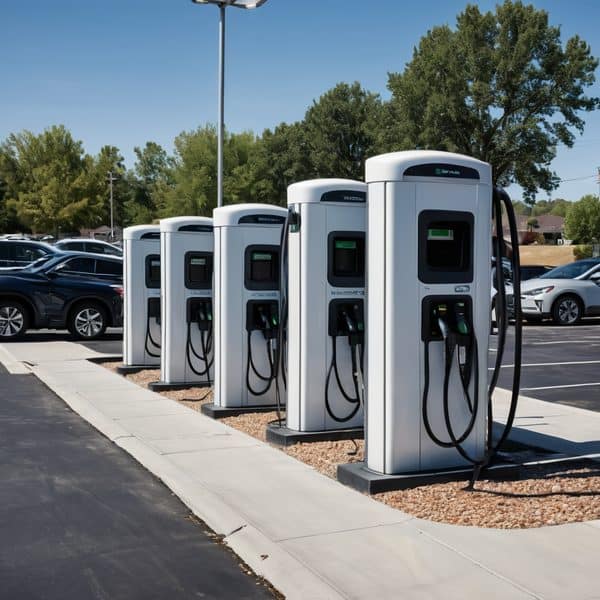
A Trump administration proposal to require that federally funded electric vehicle charging stations use 100% U.S.-made parts — up from the current 55% Buy America threshold — could leave roughly $5 billion in federal funding unusable and slow nationwide deployment, a coalition of 20 state attorneys general warned in a letter published March 16.
The letter, signed by attorneys general from states including California, Colorado, Arizona, New York, Virginia, Illinois and Michigan, urged the U.S. Department of Transportation not to finalize the stricter rule. “This would be impossible for manufacturers to achieve, frustrate congressional intent, and impair the public interest by slowing or halting federally funded EV charger deployment nationwide,” the state officials wrote, arguing the change would create an immediate and crippling barrier for projects financed under a 2021 infrastructure law.
The $5 billion in question was allocated by Congress to expand the nation’s public charging network. The Trump administration has previously moved to suspend the program; that suspension was blocked in litigation by a coalition of states in a decision by U.S. District Judge Tana Lin. It remains unclear when — or if — the money will be put to use should the new Buy America condition be finalized, the attorneys general said.
While the state officials said they support Buy America policies in principle, they argued the proposed 100% domestic-content requirement is not practicable. “There are currently no 100% domestically produced chargers available for purchase, there is not enough demand for 100% domestically produced chargers to justify investing in domestic production, and some critical components of the chargers are simply not produced in the United States,” the letter said.
Kentucky Governor Andy Beshear, whose state joined the opposition, framed the proposed rule as another attempt to stymie congressionally mandated funding. The Department of Transportation’s proposal, if finalized, would take effect immediately, raising the prospect that eligible projects could be delayed or left without federal support while manufacturers and procurement networks adapt — or fail to do so.
The Biden-era expansion of EV infrastructure has already produced a sizable public network: the Department of Energy counts more than 84,000 public charging stations and over 270,000 charging ports nationwide. But the attorneys general and industry groups warn that a sudden jump to a 100% domestic-parts requirement could stall further growth. The DOT’s proposal now faces sustained pushback from state officials and industry, and could prompt additional legal challenges or congressional scrutiny as stakeholders debate how to balance Buy America objectives with supply-chain realities.