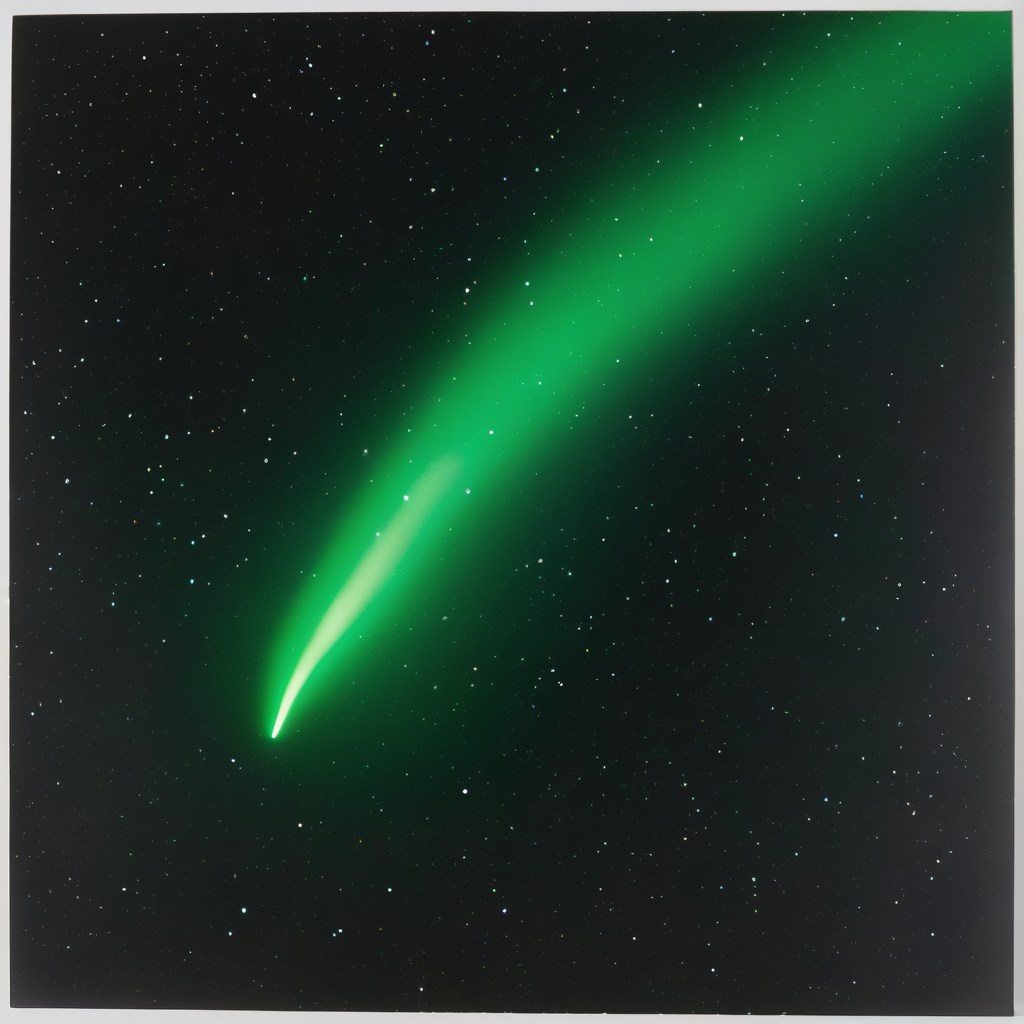
Recent observations from the Gemini North telescope reveal that the interstellar comet 3I/ATLAS has become noticeably brighter and greener since its close encounter with the sun in late October. As the comet speeds towards its closest point to Earth next week, astronomers are anticipating potential new outbursts of cometary material.
Captured on November 26 from the summit of Mauna Kea in Hawaii, these images showcase the comet during one of its most active phases to date. The intense solar radiation has caused the ice on 3I/ATLAS to sublimate, releasing gas and dust into space. This process has resulted in a bright, cloudy coma surrounding the comet’s nucleus and a lengthy, luminous tail trailing behind.
Using four different filters—blue, red, orange, and green—the research team observed a distinct greenish hue emerging from the gases in the comet’s coma. This green glow can be attributed to the presence of diatomic carbon (C2), a molecule that emits green light when released into space. While many comets exhibit a similar hue when heated by solar radiation, 3I/ATLAS was initially observed as a redder object back in late August, indicating it is now expelling new molecules as it encounters increased solar heat.
As 3I/ATLAS approaches Earth on December 19, coming within approximately 170 million miles (270 million kilometers) of our planet, scientists are pondering what other surprises might be in store. Observations indicate that as the comet cools after leaving the sun’s vicinity, it could trigger new outbursts of gases and chemicals. The National Science Foundation’s NOIRLab stated that the responses of comets to solar heat can often result in delayed reactions, leading to further activity after their sunward approach.
Discovered in June 2021, 3I/ATLAS is notable as the third interstellar object identified, following 1I/’Oumuamua and 2I/Borisov. Currently traveling at an extraordinary speed of about 130,000 mph (210,000 km/h) on a hyperbolic trajectory, this comet is likely the largest and oldest interstellar object observed to date. While 3I/ATLAS displays intriguing characteristics from its long journey through interstellar space, astronomers overwhelmingly conclude that it is a natural comet and not a piece of artificial technology, quelling any sensational claims to the contrary.
This exciting time for observers and researchers alike may offer more astonishing discoveries as 3I/ATLAS makes its approach, reminding us of the dynamic and ever-changing nature of our cosmos.