
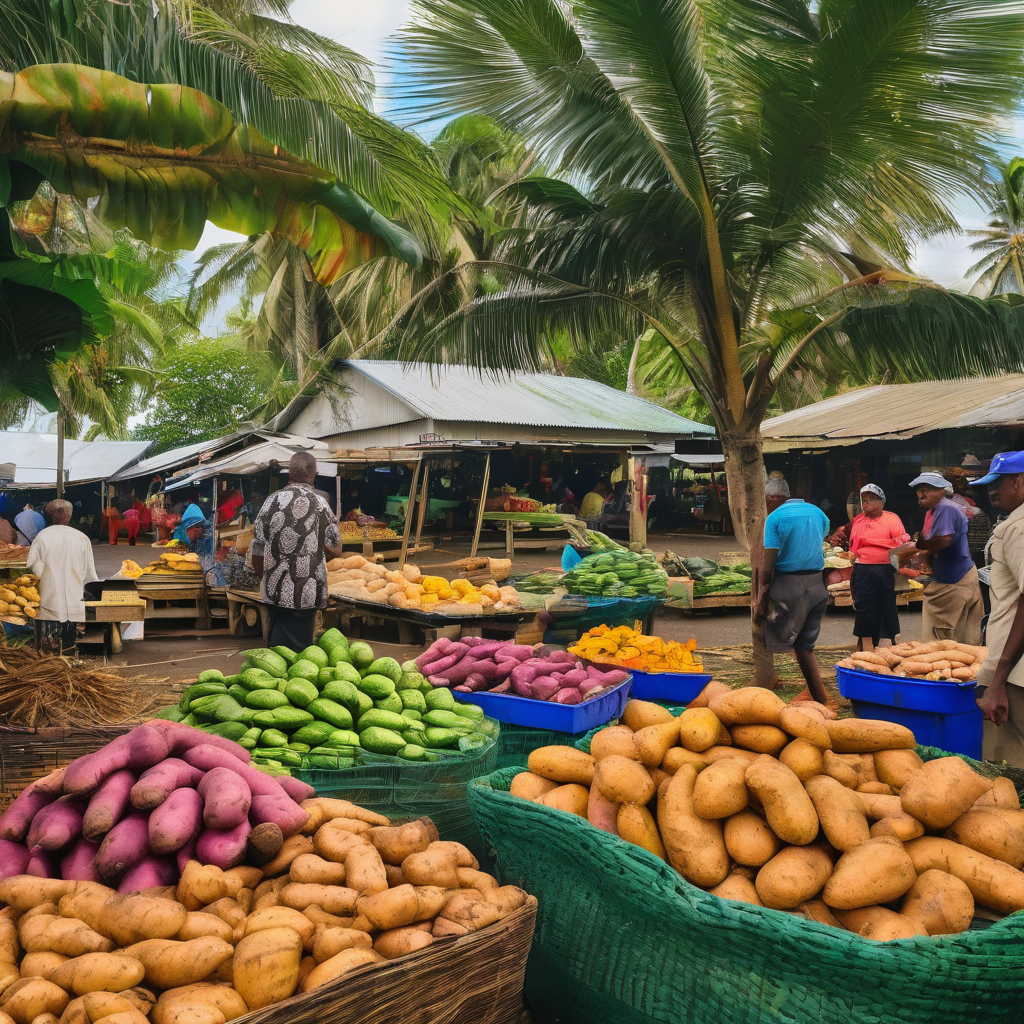
In the vibrant Lautoka Municipal Market, Takelo Sorovou has made a name for himself, running a flourishing stall adorned with dalo and kumala. His entrepreneurial journey began in 2019, amidst the challenges posed by the global pandemic and lockdowns that dramatically altered the livelihoods of many.
Mr. Sorovou recalls the pivotal moment when necessity drove him to take action. “I started during Covid in 2019 when there was a lockdown in the city. With the city shut down, employment vanished, and financial stability dissolved. I had a lot of financial problems. I couldn’t get a job. I couldn’t get insurance. I was in lockdown,” he reflected, indicating the significant hurdles he had to overcome.
Determined to provide for his family despite the uncertain circumstances, Mr. Sorovou ventured into entrepreneurship. “We had to come out and do something. That’s why I came to start up,” he explained. With limited initial resources, he launched his stall with just a small bag of cassava.
Establishing his business was anything but easy. The high costs associated with operating during the pandemic forced him to manage his resources meticulously. “During Covid, it was very expensive, maybe $120, $150, and you had to make do with what you could do to get a profit,” he said.
Initially viewing the stall as a temporary solution, Mr. Sorovou’s perspective shifted as he built connections in the market. “I came here and met some new friends. They taught me how to go through business in the market, because business in the market is different from other businesses. So, I learned from them and now I’m enjoying it,” he noted.
What began as a modest venture has evolved into a successful operation, with Mr. Sorovou expanding his stall significantly. “I started with only one bag of cassava when I came here. That’s the only thing I could afford. But now you can see, I’ve got more stalls here,” he stated proudly.
Over the years, the dynamics of the market have changed. “Before, we used to have seasons, good season, low season, but now a lot of functions are going on. Every weekend, there’s a function, so people will come in and buy dalo, kumala. So there’s a feast every day,” he described. He highlighted that sales soar during the end of the calendar year, particularly during the Christmas season, which brings an influx of customers seeking festive goods.
The rewards of his hard work extend beyond financial gains. Mr. Sorovou cherishes the ability to cultivate a loyal customer base and manage his own schedule. “One good thing too, I’m starting to bring in my customers. When they want dalo, they call me. Or they come here. They want cassava, kumala, they come here,” he said.
For aspiring vendors, Mr. Sorovou advocates for the importance of patience. “One of the things I learned here is patience. When you stay here, you’re patient. You’ll not get $100 a day, every week, every day or $200 every day for your sales. Sometimes you’ll get more, sometimes you’ll get less. But if you have patience, as soon as you build up customers, you’ll have no problem,” he advised.
Support from his family has been instrumental to his success. “I have my family too. My brothers and sisters who are supporting me. They work overseas. They buy from me and send it to my friends,” he shared.
Mr. Sorovou’s greatest achievement is the flexibility his business provides as a parent. With children in university, being his own boss allows him to be present for important moments in their lives. “I can look after my children. I don’t need to ask for a bus to give me permission to go and see them in school. So, whenever the teachers call or the school needs me, I’m there,” he revealed.
Together with his wife, who works for the Biosecurity Authority of Fiji, they now enjoy a stable household income. “We might say we’re our own boss, but we have to really work hard. Every morning I wake up. Sometimes at 2 am or 3 am I off-load my dalo here. You might make some sacrifices, but the reward is sweet,” he concluded, embodying the spirit of resilience and determination that defines many small business owners today.