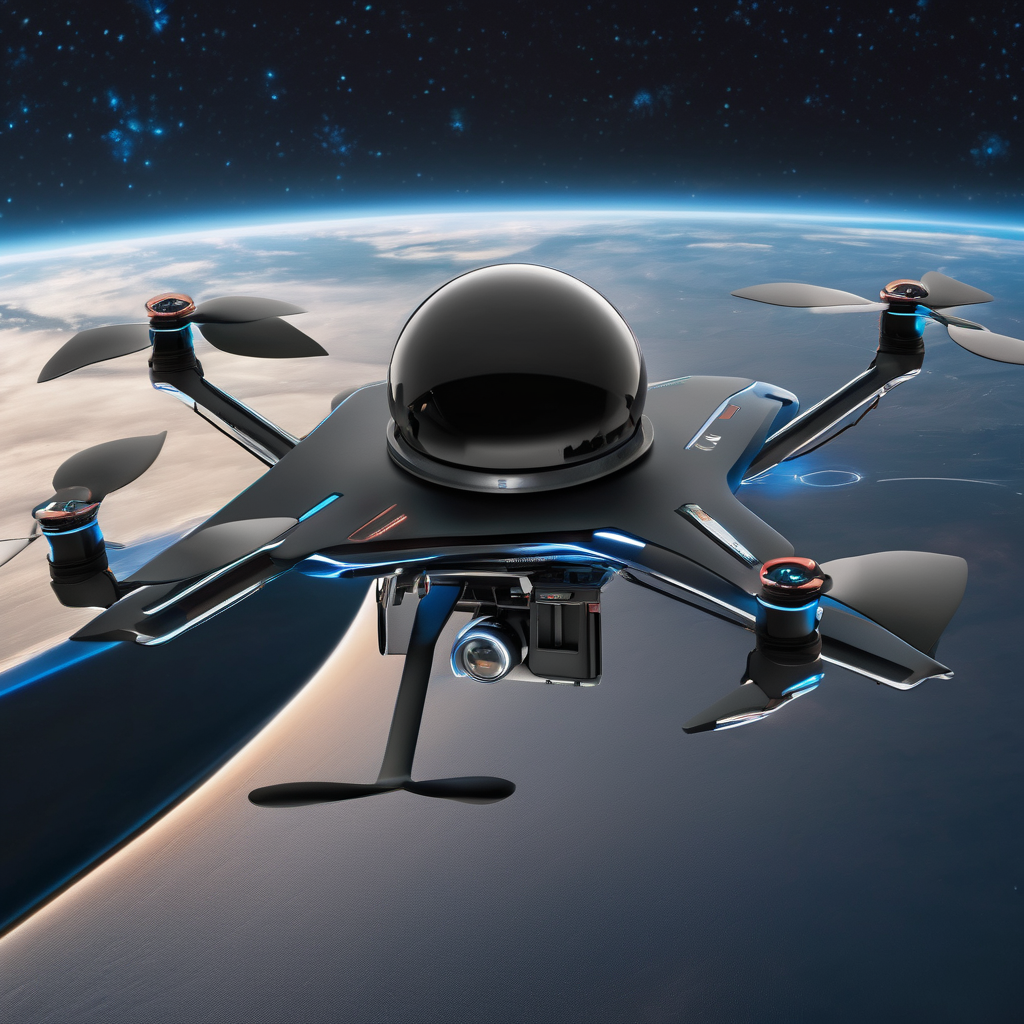
A recent video shared by a China Central Television YouTube channel has thrown the spotlight on notable advancements in the realm of autonomous aerial vehicles, including remarkable models like the Wing Loong II Long Range Drone and the Lanying R6000 Tiltrotor. While these models showcase significant achievements for a nation that has come a long way from its historical roots, the most intriguing highlight was the conceptual spacecraft known as the Luan Niao.
The Luan Niao is designed as an orbital mothership capable of launching uncrewed fighter drones and “hyper-ballistic missiles” from the outer edges of space. According to reports, its specifications unveil an impressive structure measuring nearly 800 feet in length and roughly 2,244 feet in width, with a potential weight of up to 120,000 tons. This massive craft could carry 88 “Xuan Nu” autonomous fighter drones, which are also conceptual models and represent a 6th generation fighter jet still under development. These fighter drones have been presented at various technology exhibitions since 2019 to inspire future engineers and scientists.
The designs for both the Luan Niao and the Xuan Nu have been reignited through ambitious 3D renders as part of the “South Heaven Gate Project,” a strategic initiative to unify China’s aerospace and defense sectors under a cohesive vision. The announcement of this project has ignited excitement among Chinese netizens, inspiring a wave of fictional narratives depicting a future where the People’s Republic operates a fleet of Luan Niao carriers managing global operations.
Defense expert Peter Layton highlights that if the Luan Niao comes to fruition, it could potentially surpass existing military capabilities around the globe. He mentions that such a spacecraft would allow China to deploy military assets virtually anywhere, unaffected by weather conditions or conventional defensive measures thanks to its elevated operational altitude.
While the prospect of launching a 120,000-ton spacecraft may present daunting technical challenges, the rapid technological advancement exhibited by China in recent years suggests that what seems unattainable today could very well become reality in the near future. This ambitious vision speaks to the growing aspirations of a nation aiming to carve its presence in the global aerospace and defense arena.