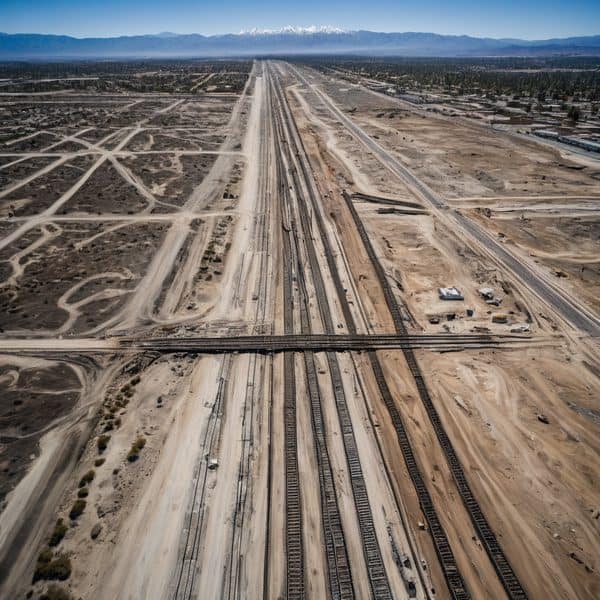
CBS’s 60 Minutes on Sunday cast a harsh light on California’s long‑promised high‑speed rail, calling the once‑ambitious Los Angeles–San Francisco project a “ghost train” and spotlighting a new state estimate that the program will cost roughly $125 billion. More than 18 years after voters approved the scheme, the show said, there are still no tracks connecting the state’s two largest cities and lawmakers and officials are scrambling to explain how costs and timelines diverged so dramatically from the original vision.
The rail plan was approved by Californians in 2008 with roughly $9.95 billion initially earmarked and early projections that the full system would cost about $33 billion. Instead, the California High‑Speed Rail Authority — and a board member interviewed by 60 Minutes — now cite a price tag in the neighborhood of $125 billion. The project has been scaled back from the original LA–San Francisco route to a more modest initial build of track in the Central Valley between Bakersfield and Merced.
Correspondent Jon Wertheim singled out a cluster of causes for the cost overruns and delays, including California’s stringent environmental review process, which has spawned multiple regulatory reviews and lawsuits. “As anyone whose renovated a home knows, delay adds to price,” Wertheim quipped on air, also noting that higher U.S. labor and construction costs compared with other countries have exacerbated budget pressures.
Political and planning failures also featured in the segment. Representative Vince Fong (R‑Calif.) told CBS the 2008 plan was “very theoretical,” and said it had become “very clear they didn’t have the specifics worked out.” “We’re now in 2026. There are no trains, there’s no track laid,” Fong said. “It’s a complete bait and switch.” California Secretary of Transportation Toks Omishakin acknowledged the breadth of the miscalculation, telling Wertheim that “I don’t think the voters fully understood — and neither did we in the public sector — what it was going to take to actually get this project delivered.”
Anthony Williams, a High‑Speed Rail Authority board member and former legislative affairs secretary for Gov. Gavin Newsom, conceded on camera that financing was insufficient at the project’s start. “It wasn’t. Let’s be real,” Williams said when asked whether the funding to finish the original plan had ever been in place. The program’s champions over the years have included then‑governor Arnold Schwarzenegger in 2008 and his successor Jerry Brown, who directed cap‑and‑trade revenues and signed legislation to release bond funds. Newsom, after wavering in the mid‑2010s, returned to supporting the project; the governor did not respond to multiple interview requests from 60 Minutes, the program said.
Wertheim also highlighted the scale of the funding gap: the roughly $125–126 billion estimate represents “more funding than Amtrak has received in its history,” and still leaves an approximate $90 billion shortfall to complete the originally envisioned network. California officials say they aim to begin laying the first tracks in the Central Valley this year — a milestone now slated for 2026, about six years after the project was originally supposed to be finished.
The 60 Minutes profile underscores the political and fiscal headache facing state leaders as they try to deliver a downsized section of high‑speed rail while confronting lawsuits, cost inflation and skepticism from some federal and local officials. With construction only now set to begin on a limited segment and the majority of the original route unfunded, the future of California’s high‑speed rail remains uncertain.