
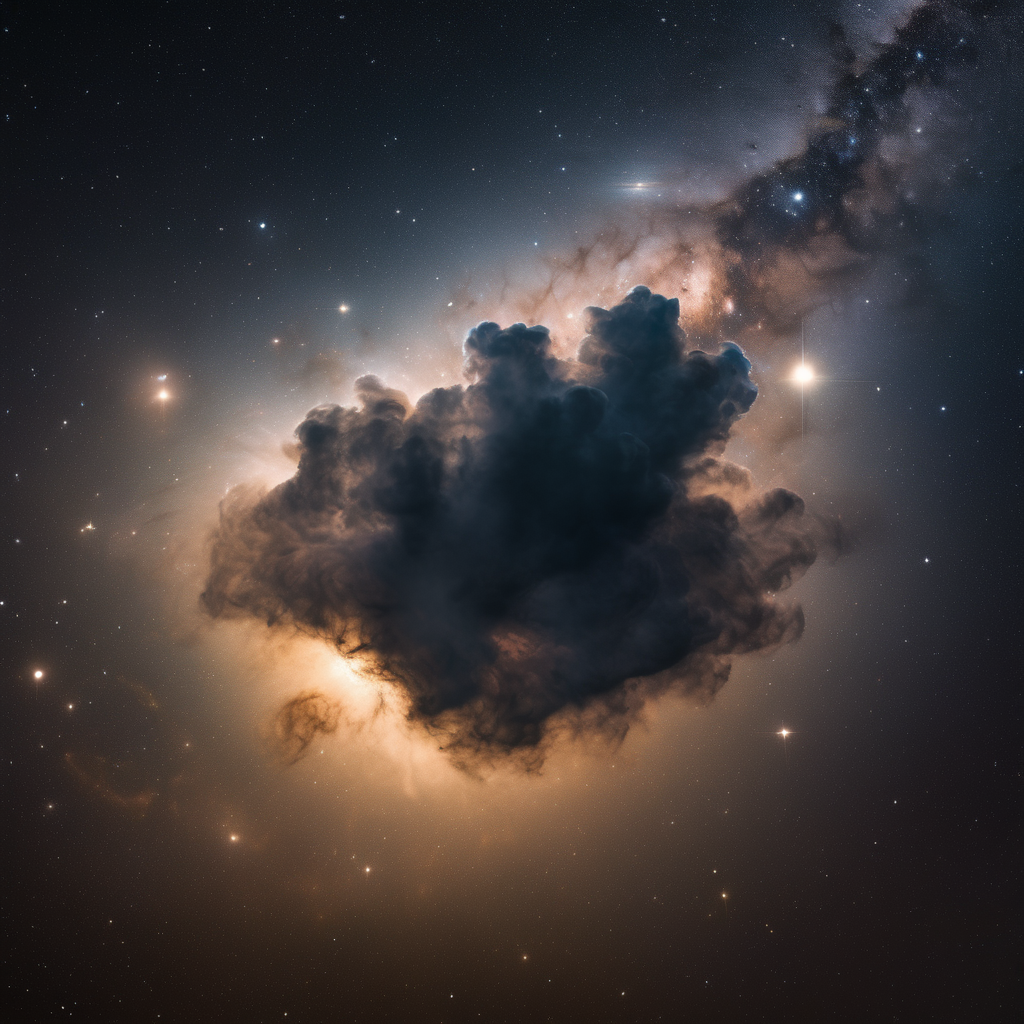
A groundbreaking discovery by a team of researchers has unveiled a new astronomical object that offers significant insights into the formation of galaxies and the evolution of the early universe. NASA has designated this intriguing find as “Cloud-9,” describing it as a starless, gas-rich dark matter hydrogen cloud located approximately 14 million light-years from Earth.
For years, scientists have theorized the existence of such objects, but Cloud-9 marks the first confirmed detection of its kind, according to NASA. These clouds are thought to consist of dark matter that has not accumulated sufficient gas to initiate star formation.
The identification of Cloud-9 dates back three years; however, it was only recently that the Hubble Space Telescope was utilized to confirm its starless nature. Alejandro Benitez-Llambay, an assistant professor at Italy’s Milano-Bicocca University and the principal investigator on the Hubble team, emphasized that Cloud-9 symbolizes a “failed galaxy.” He remarked, “In science, we usually learn more from the failures than from the successes. In this case, seeing no stars is what proves the theory right.”
With a diameter of approximately 4,900 light-years, the core of Cloud-9 is composed predominantly of neutral hydrogen, with a mass estimated to be around one million times that of the Sun. Additionally, the cloud harbors a significant quantity of dark matter—estimated to be about five billion solar masses. Andrew Fox, a team member involved in the study of Cloud-9, referred to it as a “window into the dark universe,” highlighting its potential to offer insights about the elusive dark matter that constitutes most of the universe’s mass yet remains challenging to observe due to its inability to emit light.
NASA indicated that the discovery of Cloud-9 suggests a plethora of other similar small, dark matter-dominated structures may exist in the universe, many of which are difficult to study because brighter celestial objects often overshadow them. Historically, researchers have concentrated their efforts on these brighter counterparts, making Cloud-9’s findings particularly valuable.
Notably, Cloud-9 is the ninth gas cloud recorded on the periphery of the nearby spiral galaxy Messier 94. It stands out due to its smaller size, compactness, and highly spherical shape, and it appears to have a physical association with Messier 94. The ongoing research will include further surveys aimed at enhancing understanding of dark matter, failed galaxies, and the early stages of the universe’s development.
As researchers investigate Cloud-9, they remain hopeful that this object may continue to evolve and potentially develop into a galaxy in the future, providing an exciting prospect for future astronomical studies. The discovery reiterates the role that unanticipated findings can play in expanding our understanding of the cosmos, helping to piece together the complex puzzle of galactic formation.