
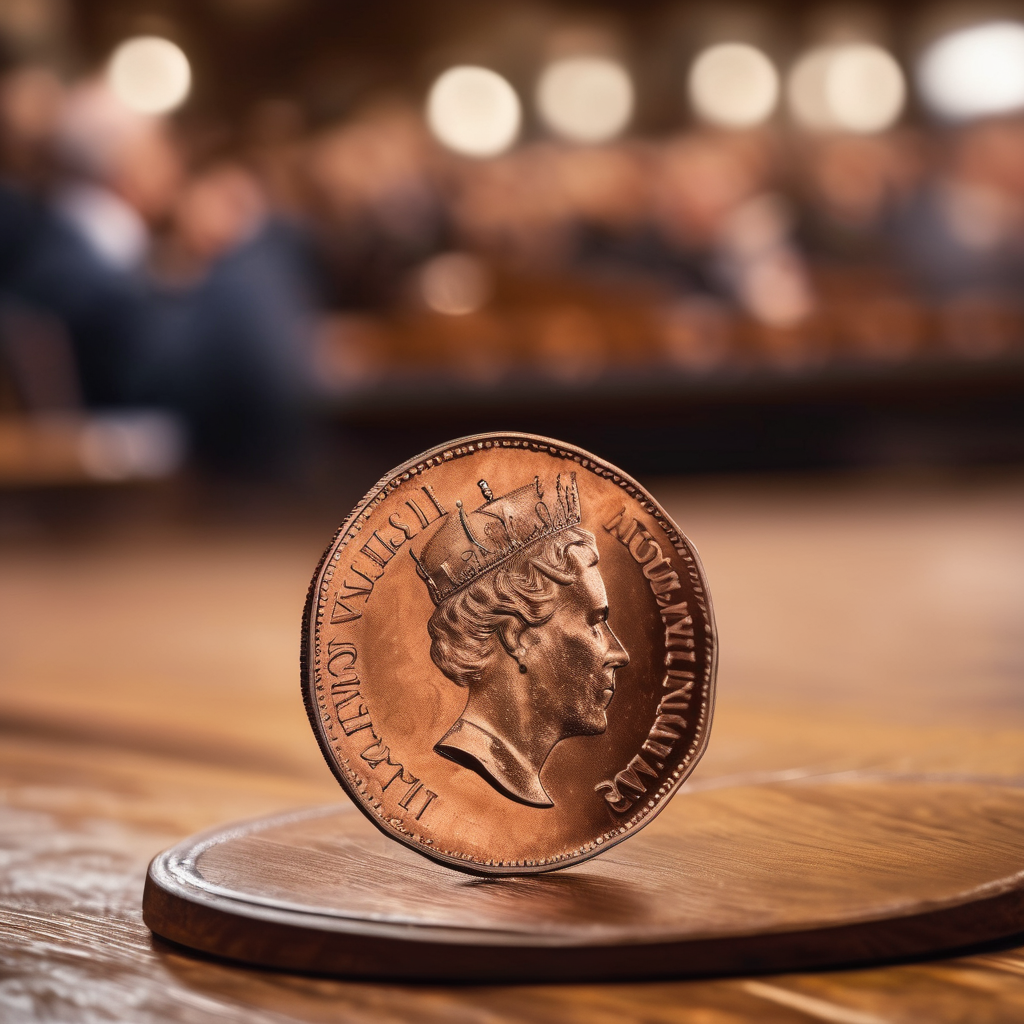
The recent auction of the final minted U.S. pennies has transformed loose change into a coveted treasure for collectors and casual savers alike. The U.S. Mint’s decision to end penny production in November 2025 led to a remarkable auction where the last three one-cent coins each fetched staggering prices, totaling over $16 million.
The event, held shortly after the cessation of penny production, saw 232 sets of three pennies sold, raising an impressive $16.76 million in just four hours of intense bidding. Among the highlights, the last three pennies alone sold for a jaw-dropping $800,000, showcasing the remarkable value that even the most humble coin can hold.
John Kraljevich, director of numismatic Americana at Stack’s Bowers, expressed his astonishment at the auction’s unprecedented nature. He emphasized that in his 40 years of attending coin auctions, he had never witnessed anything quite like it. The end of penny production was reportedly prompted by former President Trump’s awareness that it cost more than double to produce each penny than its face value.
The sudden halt in penny circulation resulted in a coin shortage that left retailers scrambling to adapt to cash transactions. Many retailers chose to round purchases to the nearest nickel, leading to some confusion at checkouts, as certain customers found themselves charged more than their actual orders.
Amid this backdrop of change, collectors have turned their attention to zinc and copper pennies, hoping to discover rare finds tucked away in their pockets or jars. Although the auctioned pennies are unlikely to appear in daily circulation, there are still some valuable indicators for identifying rare coins.
Notably, collectors should keep an eye out for specific characteristics that could indicate high-value pennies, such as:
– An omega symbol (Ω) on a 2025 penny located near Lincoln’s shoulder.
– A combined “S” symbol with specific years like 1931 or 2021, indicating coins minted in San Francisco.
– The initials “V.D.B.” on the back of a coin, which stand for Victor David Brenner, the designer of the Lincoln cent.
– 1922 pennies lacking a “D” symbol, known as “plain cents.”
– Pennies that do not stick to magnets, indicating they are made of pure copper and could potentially be valued as high as $100,000.
– 1944 pennies that do stick to magnets; a misstruck steel penny from this year sold for $408,000 in 2021.
With these factors in mind, coin collectors are experiencing a surge of excitement and interest, as many enthusiasts take a closer look at their own collections. This booming interest reflects a growing appreciation for numismatics, which allows people to celebrate the historical value and craftsmanship behind coins that were once taken for granted. As collectors dive into their change jars, they may find that their seemingly ordinary pennies could hold extraordinary value.